
Managing petabytes of unstructured data can feel impossible when you rely on an operating system’s search tools. Whether it’s Windows, Mac or Linux, each search crawls through millions of files, slowly and painfully. And let’s not even start to think about searching across object, storage platforms and archives. That’s where the Diskover index comes into play, solving this with a smart approach: metadata indexing.
Here’s how the Diskover indexing system turns unstructured data management from painful to powerful.
What is a Diskover Index?
A Diskover index is a complete inventory of your warehouse taken at a specific moment in time. Instead of walking down every aisle to find boxes and products, you check the inventory database and you know exactly where your stuff is.
A Diskover index contains a snapshot of file metadata across any storage type:
- File and directory names
- File sizes and extensions
- Creation and modification dates and times
- Ownership and permissions
- Custom business metadata
What’s the different between filesystem searching? A Diskover index lets you search billions of files, across multiple storage platforms and classes. These searches take seconds, not hours. There’s more waiting for recursive directory scans or sysadmin “find” commands.
How Diskover Creates and Maintains Indexes
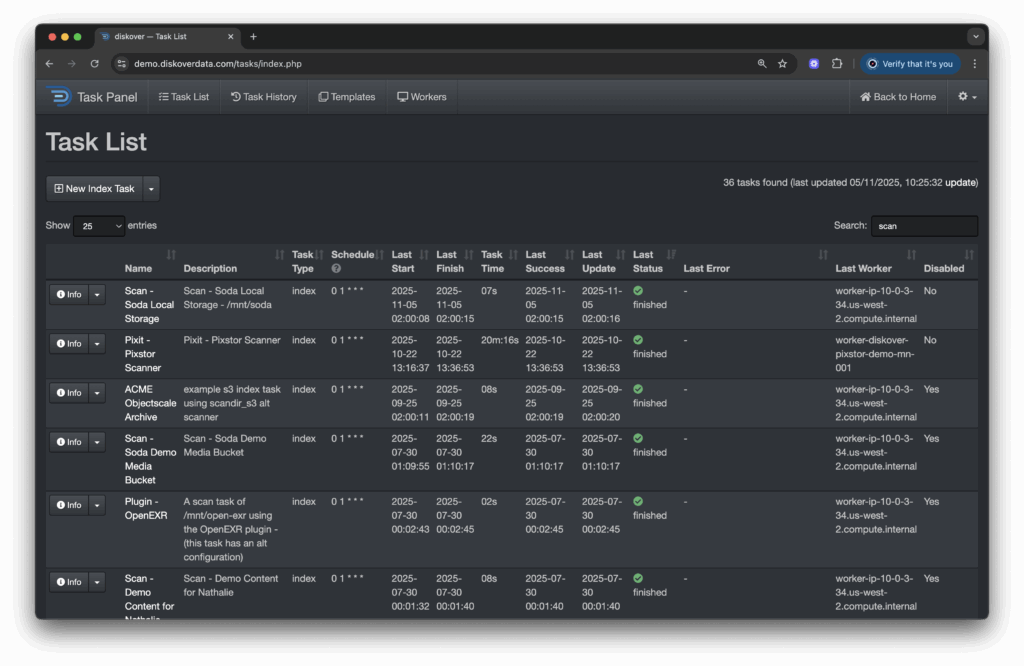
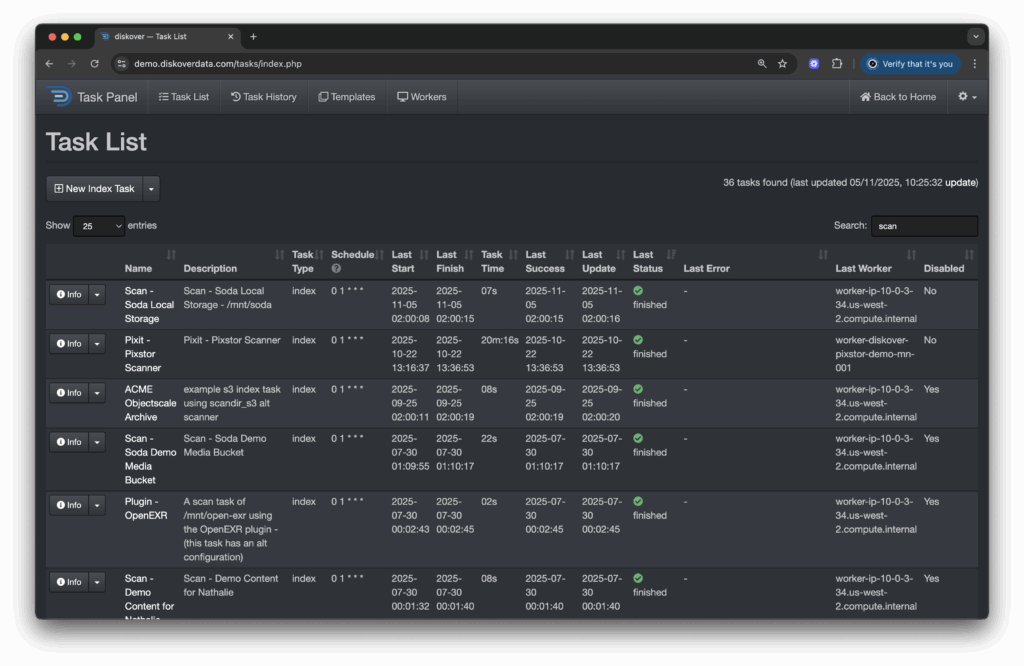
Diskover indexes storage volumes on a schedule, and thanks to its task management architecture it can scan multiple locations simultaneously (not one volume at a time). So each index is a picture of the current state of data on the relevant storage device. The Diskover Administrator configures the scanning schedule based on your organization’s needs.
For high-velocity environments like media production, Diskover can be configured to scan on an hourly basis. Every scan creates a new index, and indexes can be compared using the heatmap tool to compare file growth and changes over time.
Using Indexes for Unstructured Data Management
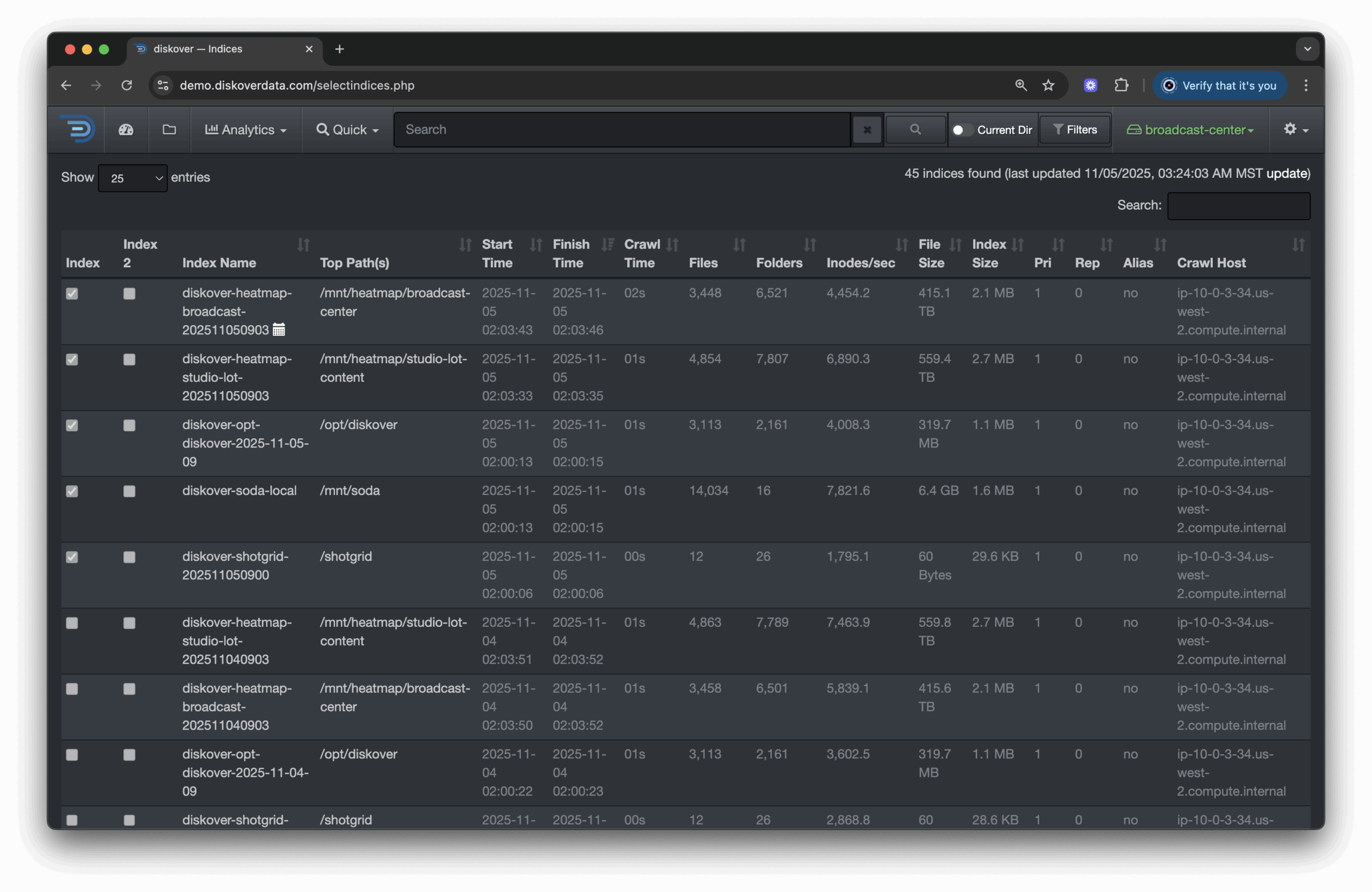
Diskover can manage indexes for hundreds or even thousands of storage devices across your enterprise. Using the Settings → Indices menu an administrator can manage these indexes.

Always Use the Latest Data
The default setting “Always use latest indices” makes sure that every search query in the main Diskover interface uses the most current data across all storage volumes. This is the most common configuration and makes sure users see the latest picture of your unstructured storage estate.
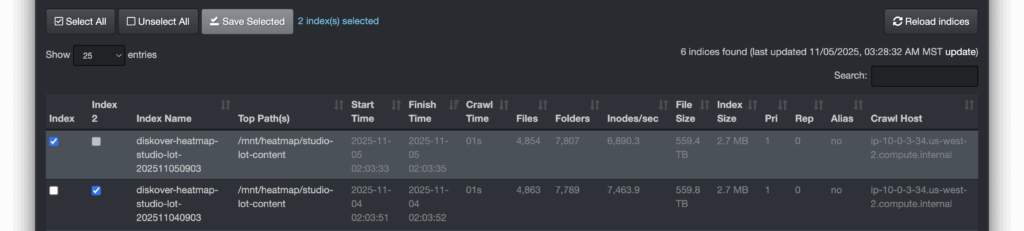
Select Specific Indexes for Comparison
By deselecting “Always use latest indices” it is possible to target individual indexes for specific storage devices or points in time. This activates the heatmap tool, for:
- Analysing storage growth trends over time
- Comparing file access patterns between quarters
- Investigating what existed before a major project cleanup
- Generating compliance reports for specific time periods
Filter and Focus Your Data View
The Diskover index interface also lets you filter by age, keywords, or selecting specific volumes. This flexibility lets administrators narrow down the main Diskover UI from displaying billions or files and petabytes of data to a certain subset of data relevant to what you need.
The Business Value of Indexed Unstructured Data Management
Traditional storage management tools either force users to scan systems every single time someone searches, or limit the amount of data that can be searched to a single storage class or vendor. This approach doesn’t scale when you’re managing multiple petabytes across different storage types and from different manufacturers.
The Diskover indexing architecture solves the unstructured data management challenge at scale. Instead of performing recursive file system crawls when a user searches, that might take hours, users can instantly search across the entire data estate.
Once we can work at this speed thanks to Diskover indexes, we can enable:
- Data lifecycle automation based on accurate, current metadata
- Cost optimisation by identifying ROT data (Redundant, Obsolete, Trivial)
- Compliance management through rapid data discovery and classification
- Strategic planning using historical trends and forecasting
The Bottom Line
Diskover lets us transform unstructured data management from a daunting or impossible task to an automated process that sits quietly in the background until it is needed. By creating metadata indexes of your entire storage environment, administrators and users do not need to react to unstructured data management tasks, but they can be more proactive in managing storage and data.
Rather than fighting storage systems with slow searches and incomplete results, Diskover’s indexes let you have a complete, accurate picture of your unstructured data, making sustainable data management possible and practical.