

The MrBeast channel has posted 9.5 hours of finished content in 2025 so far. 24 videos have generated 3.3 billion views. That’s 347 million views per hour of content.
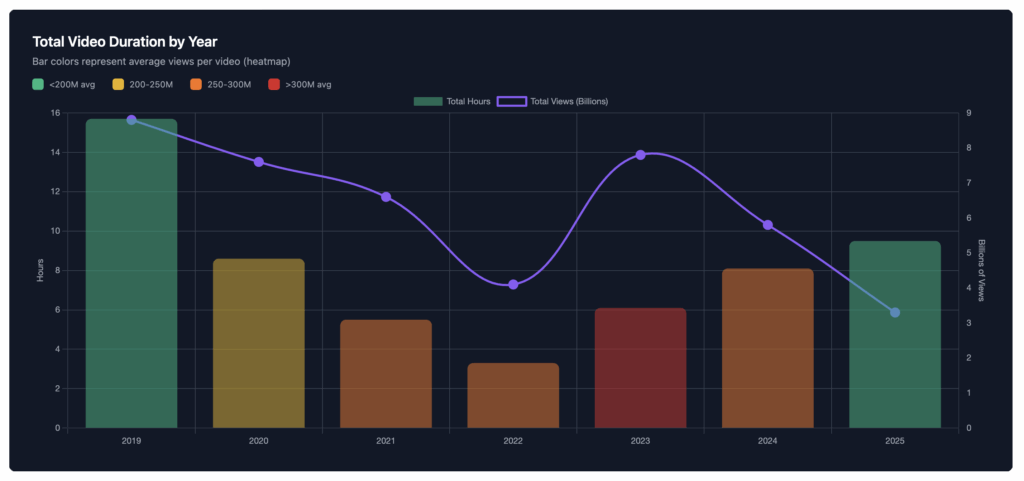
No studio or tv company comes close. MrBeast operates at an efficiency ratio 5 – 10x traditional content creators.
The economics flip when you’re this efficient, but… efficiency in distribution creates production complexity. Here’s the math:
Traditional production ratio: 10:1 (raw to finished)

9.5 hours finished × 10 = 95 hours raw footage

At 400 GB/hour (4K ProRes): 38 TB

MrBeast actual ratio: 100:1 (and climbing)

9.5 hours finished × 100 = 950 hours raw footage

At 400 GB/hour (4K ProRes): 380 TB for one year
A 100:1 ratio isn’t speculation. Talking about their “Ages 1-100” video, Jason Elliott, MrBeast Director of Photography said
“We rigged every single contestant cube—all 100 of them—with 3 cameras each.”
That’s 300 cameras as a baseline.
The production created several petabytes of data at 1080p. For the Beast Games on Prime, they used a record 1,107 cameras simultaneously.
Elliott explains,
“Because a lot of MrBeast content is unplanned and unscripted, all our cameras must be actively recording for 24hrs a day until the content is over.”
Production values change because the economics have changed. YouTube pays per view, not per hour of content. So MrBeast content is optimised for views per minute. In production that means 300 cameras to capture every possible angle.
Shooting 100 hours to get 10 minutes of perfect content is a different production approach for a different business model. And a different data management challenge.
Here’s my estimate on what is in the Beast archive today: Average 11 hours of finished content per year since 2018. At 100:1 ratio, that’s 7,700 hours of raw footage. At 400 GB/hour for 4K, that’s 3.52 petabytes of production data.
MrBeast generates the same amount of data per year as an International TV Network.
If TV Networks began this evolution with Reality TV, then MrBeast has completely inverted the production model. Traditional studios minimised footage to control costs. MrBeast maximises footage to maximise engagement. One creates 10 hours of raw content to deliver 1 hour of finished product, the other creates 100 hours, then scales that to 300 or more cameras with continuous recording.
This inversion is only possible because the gatekeepers have gone. Without network executives controlling broadcast schedules, budgets and runtime, creators can optimise for views-per-minute instead of cost-per-hour. When YouTube pays per view rather than per hour of content, it’s economically rational to capture everything: 24/7 recording, 300 cameras, petabytes per project.
The constraint isn’t production capacity anymore. It’s data infrastructure.
So what does it cost to store? That’s the wrong question. Storage is cheap. The real cost is in not having the infrastructure to compete with creators who’ve already inverted the model. Every studio, network, and production company looking at MrBeast’s efficiency numbers are asking: “If YouTube’s economics work at this scale, how do we compete?”