
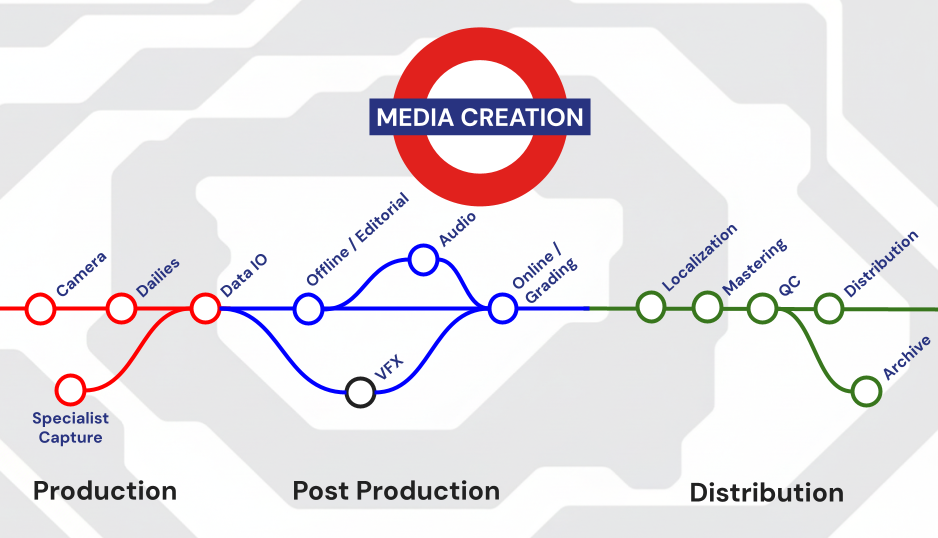
In 1931, Harry Beck’s Underground map was rejected as “too radical” After a test run of 500 copies in 1932, London Underground printed 700,000 maps in 1933 and a reprint was needed within one month.
What code had Beck cracked? Passengers don’t care about geographic accuracy; they care about connections.
Media workflows break for the same reason London’s first transit maps failed: they don’t focus on the connections. Operational teams focus on their portion of the track, and executives never achieve get the true picture of where projects go and when they’ve finished
Production: The Capture Station
Every production starts with capture. Mainly cameras, but modern sets use motion capture, volumetric scanning, and even LiDAR systems. Every device generates different types of data that need to be immediately logged, protected and prepared for the next stop on its journey.
The stakes are high. Footage lost from a photography day is money down the drain, the talent isn’t going to reshoot an entire day again for free. This is why production teams obsess over data protection from the moment recording starts.
Post-Production: The Transformation Hub
This is where raw ingredients are crafted into finished stories. Editors assemble cuts, VFX artists use software and GPUs to create magic out of thin air, and sound designers build audio landscapes. Every craft generates working files that consume more storage than the original camera files.
The end of this line is a Gold Master Asset. A finished version ready for distribution. But there’s one more branch line on this journey.
Distribution: The Final Mile
Just like different destinations need different tickets, different platforms needs specific technical formats. Broadcast and Digital platforms have countless asset and metadata requirements. Cinema requires DCP packages. Social media demands various aspect ratios and compression types.
At the end of the line we have archive; preserving assets for future reuse. If an actor’s career takes an interesting turn or a legacy series comes back in vogue, studios can leverage their archive for decades to come.
Why the Map Matters
Every production type has its own transit map. Feature films take different routes to episodic TV. Commercials and Social Content take express lines. Documentaries make countless unexpected stops.
The mistake is treating all content production as the same. You wouldn’t use the Tokyo Metro map to navigate New York’s Subway. We don’t use a feature film workflow for social media content.
Understanding the map means knowing which stations matter for your destination. Knowing when to transfer or when to stay on your current line. Most importantly, it means seeing the whole system instead of just the next stop.
What does your production workflow map look like? More importantly – can your leadership team read it?